.png)

B2B Web Design in Toronto: A Practical Guide (for Sites That Actually Convert)
Most B2B sites in Toronto convert at 1-2%. Here's what B2B web design Toronto buyers pay for and the mistakes that kill conversions.
April 29, 2026
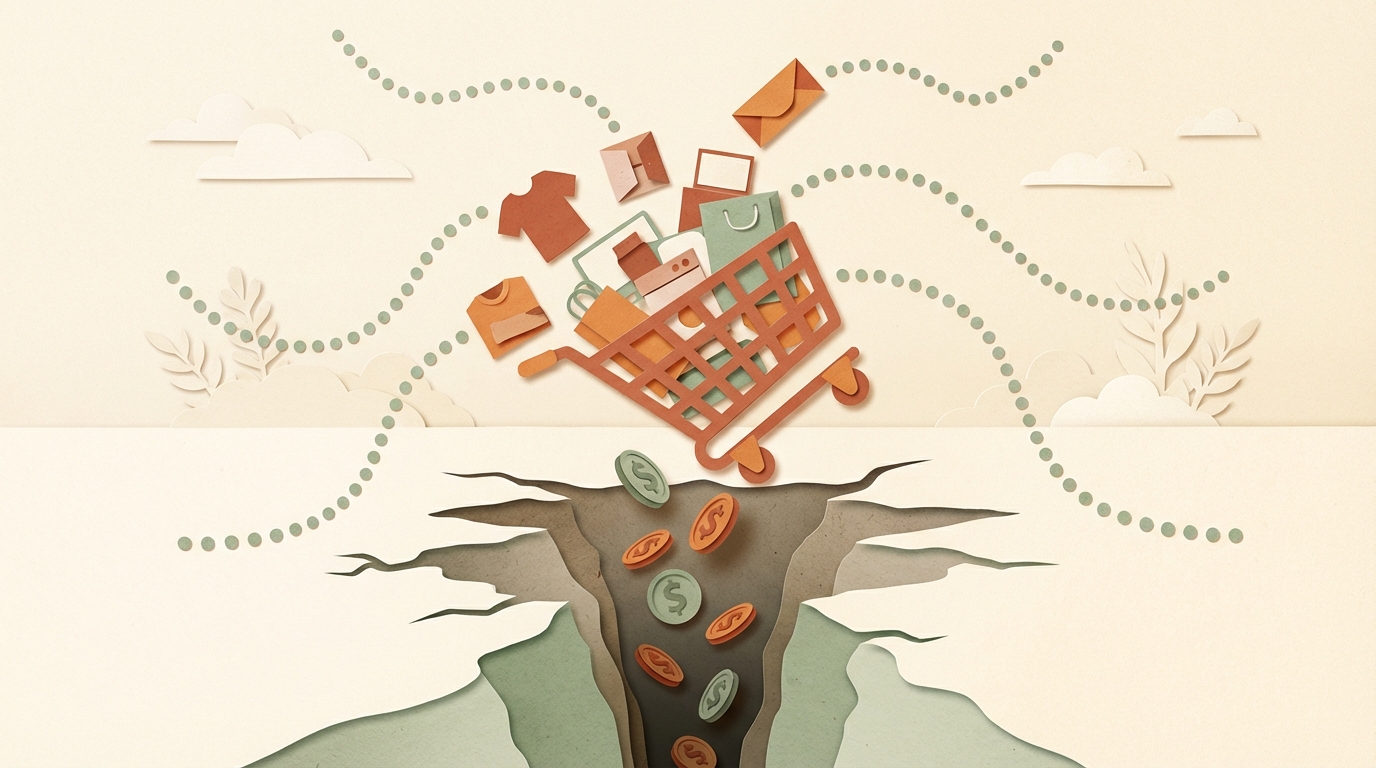
7 out of 10 shoppers abandon their cart. Learn the checkout fixes and recovery tactics that can boost your ecommerce revenue by 50% with zero extra ad spend.

For every 10 people who add something to their cart on your site, 7 of them leave without buying. That's not a rounding error. That's the majority of your revenue walking out the door.
The average global cart abandonment rate sits at 70.22%, according to Baymard Institute's meta-analysis of 50 studies. On mobile, it's even worse: 80-85%. And the total cost? E-commerce retailers lose roughly $18 billion annually to abandoned carts, with $260 billion in recoverable revenue sitting on the table across the US and EU alone.
Here's the good news: most of the reasons people abandon carts are fixable. Not with a massive replatform or a six-figure tech investment, but with targeted checkout fixes you can start making this week.
About 43% of shoppers who abandon a cart were "just browsing" with no real intent to buy. You can't fix that, and you shouldn't try. But the other 57%? They wanted to buy and something stopped them.
Here are the top reasons, ranked by how often they're cited:
Look at that list carefully. Not a single item requires a new product, a bigger ad budget, or a rebrand. Every one of these is a checkout experience problem. And checkout experience problems have checkout experience solutions. If your online business isn't selling, this is often the first place to look.
We've seen this play out with dozens of ecommerce clients. The stores that obsess over their checkout flow consistently outperform the ones throwing money at more traffic. Here's what works.
The #1 reason for abandonment is seeing unexpected costs at checkout. The fix is simple: show total costs (shipping, taxes, fees) on the product page or cart page, before the customer ever reaches checkout.
This costs nothing to set up. If you're on Shopify, use a shipping calculator widget on the cart page. If you run your own stack, surface estimated totals early. The goal is zero surprises at the payment step.
The data backs this up: free shipping alone recovers an additional 28% of abandoned carts when used as a recovery incentive. And 79% of consumers say they're more likely to shop when free shipping is offered, even if it means a slightly higher product price.
The average checkout has 14.88 form fields. The optimized benchmark? Seven.
Baymard Institute found that reducing form fields to that level can increase conversions by up to 35.62%. That's not a typo. Cutting fields from 15 to 7 can lift your conversion rate by more than a third.
What to cut:
What to keep:
One case study from an electrical equipment ecommerce platform showed that a simplified, mobile-first checkout redesign reduced abandonment by 25% and cut checkout completion time by over 40%.
40% of shoppers will leave if their preferred payment method isn't available. That's a staggering number for something so easy to fix.
Your checkout should support at minimum:
BNPL alone increases average order size by 18%. For a store doing $1M annually, that's $180K in additional revenue just from offering a payment option that takes an afternoon to integrate.
Mobile accounts for the majority of ecommerce traffic, but it has the highest abandonment rate at 80-85%. The gap between mobile and desktop abandonment is roughly 15 percentage points, which means your mobile checkout is where the biggest opportunity lives.
Quick mobile wins:
[IMAGE: Side-by-side comparison of a cluttered mobile checkout (too many fields, tiny buttons, no progress indicator) vs a clean mobile checkout (3 steps, large tap targets, digital wallet buttons)]
Even with a perfect checkout, some people will still abandon. That's where recovery comes in. And the numbers on recovery are genuinely impressive.
Abandoned cart emails have a 35.75% open rate (nearly double standard marketing emails) and generate $2.54 in revenue per email sent. That's 16x more revenue per message than a typical scheduled campaign.
Here's the timing that works:
Critical rule: Don't lead with a discount. Email 1 should be a simple reminder. Save the incentive for Email 3 as a last resort. Leading with discounts trains customers to abandon on purpose, and generic discount codes erode margins by 8-12% on recovered orders.
Real brands are seeing strong results with this approach. To'ak Chocolate hits a 56.2% open rate on their abandonment emails. Creality Store reaches 54%. These aren't outliers when the sequence is built right.
Email is great, but SMS is faster:
Keep it to 2-3 messages maximum over 48 hours. SMS fatigue is real, and one too many texts turns a potential recovery into an unsubscribe.
For shoppers who don't respond to email or SMS, retargeting ads bring back 26% of abandoners. The ROI here is strong:
A multi-channel recovery program (email + SMS + retargeting) working together typically yields a 34x return on investment.
One caveat worth knowing: holdout testing shows that 20-40% of "recovered" customers would have bought anyway without intervention. So measure your true incremental lift, not just gross recovery numbers. The real ROI is still excellent, but you want to know what's actually moving the needle versus what's taking credit for organic conversions.
Let's make this concrete. Say your store does $1M in annual revenue with a 70% cart abandonment rate.
If you reduce abandonment by just 15 points (from 70% to 55%), here's what happens:
That's a 50% revenue lift with zero increase in traffic, zero increase in ad spend, and zero new products. Just a better checkout. Your homepage might be turning clicks into cash, but if the checkout leaks, none of that matters.
Now layer on recovery:
You're looking at over $1M in additional annual revenue from a combination of checkout optimization and cart recovery. For a business doing $1M-$5M, this is the single highest-ROI project you can run.
Stop pouring money into traffic you can't convert. Start here:
Week 1: Audit your checkout
Week 2: Fix the friction
Week 3: Set up recovery
Week 4: Measure and iterate
Your next step: go to your analytics right now and look at your checkout funnel. Find the step where the biggest drop-off happens. That's your first fix, and it's probably worth more than your next ad campaign.

Most B2B sites in Toronto convert at 1-2%. Here's what B2B web design Toronto buyers pay for and the mistakes that kill conversions.

Most SaaS growth agencies in 2026 are repackaged generalists. Here are 6 red flags, real 2026 pricing, and the one question that reveals true operators.

A growth strategist builds the system that turns your business into predictable revenue. Here's what they do and when to hire one in Toronto.


.png)
